
What an anti-counterfeit hologram is, how it is made and which features make it hard to copy. A practical guide to choosing the right label.
In this guide
What a security hologram is
A security hologram is a label that changes image and colour as you tilt it. The effect does not come from ink: it is produced by microscopic gratings engraved in the material, which split the light.
Its technical name is DOVID, diffractive optically variable image device. The same principle protects banknotes, passports, identity cards and badges.
Why it protects against counterfeiting
- It is recognised at a glance. Anyone, even without training, can see whether the holographic effect is there or not.
- It cannot be copied with ordinary tools. Photocopiers, scanners and printers return a flat image with no colour change.
- It needs the original master. Without the printing master, reproducing an identical hologram involves very high costs.
How a hologram is made
The most common technique for security labels is dot-matrix, where the image is built point by point.
- Artwork. The design is prepared on a computer.
- Laser engraving. A helium-cadmium laser traces the image onto a photoresist plate. Each point is a diffraction grating a few microns wide; resolution reaches 2400 dpi.
- Nickel master. The developed plate is coated with nickel by electroforming: this becomes the printing master.
- Hot embossing. The master presses the pattern into the holographic film.
- Finishing. Adhesive, die-cutting to the required shape and laser numbering.
Production runs on two dot-matrix lines and three lines for 2D/3D holograms, plus laser markers for serial numbers.
Hologram types: 2D, 3D, dot-matrix
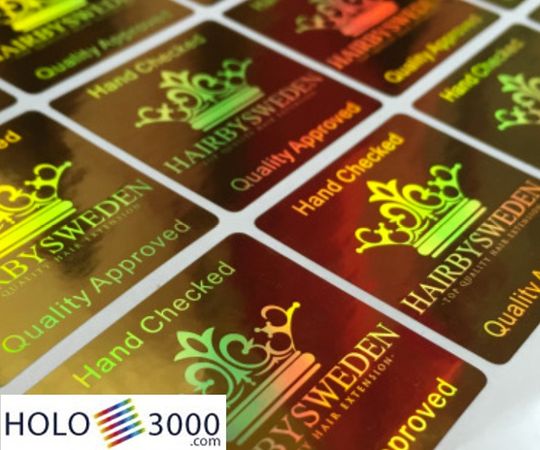
2D hologram
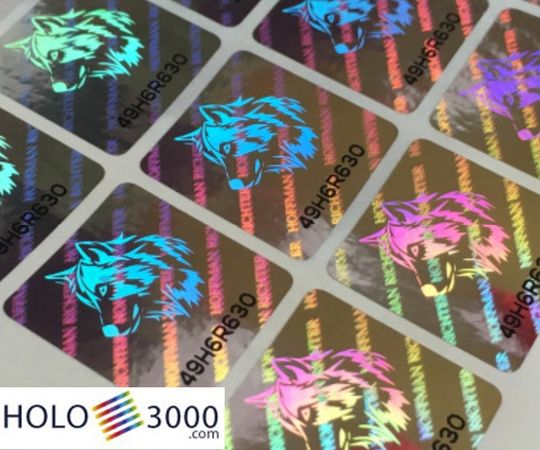
3D hologram
2D
Flat images, such as logos and lettering, that change colour as the label is tilted.
2D/3D
Several flat images set at different depths: the eye sees the planes one behind the other. Turning the label can reveal different images.
3D
Starts from a three-dimensional model: the subject seems to rise out of the surface and can be viewed from several angles.
Dot-matrix
Thousands of laser-engraved points create moving effects: expansions, rotations and flowing gradients.
Security features, level by level
A good hologram combines checks of increasing difficulty: some anyone can see, others only those who know what to look for.
With the naked eye
Holographic effect, moving images, visible serial number.
With simple tools
Microtext to read with a magnifier. Fluorescent inks and numbering that appear under a UV lamp, as on banknotes.
With dedicated tools
Hidden codes and encrypted holograms, readable only with specific equipment.
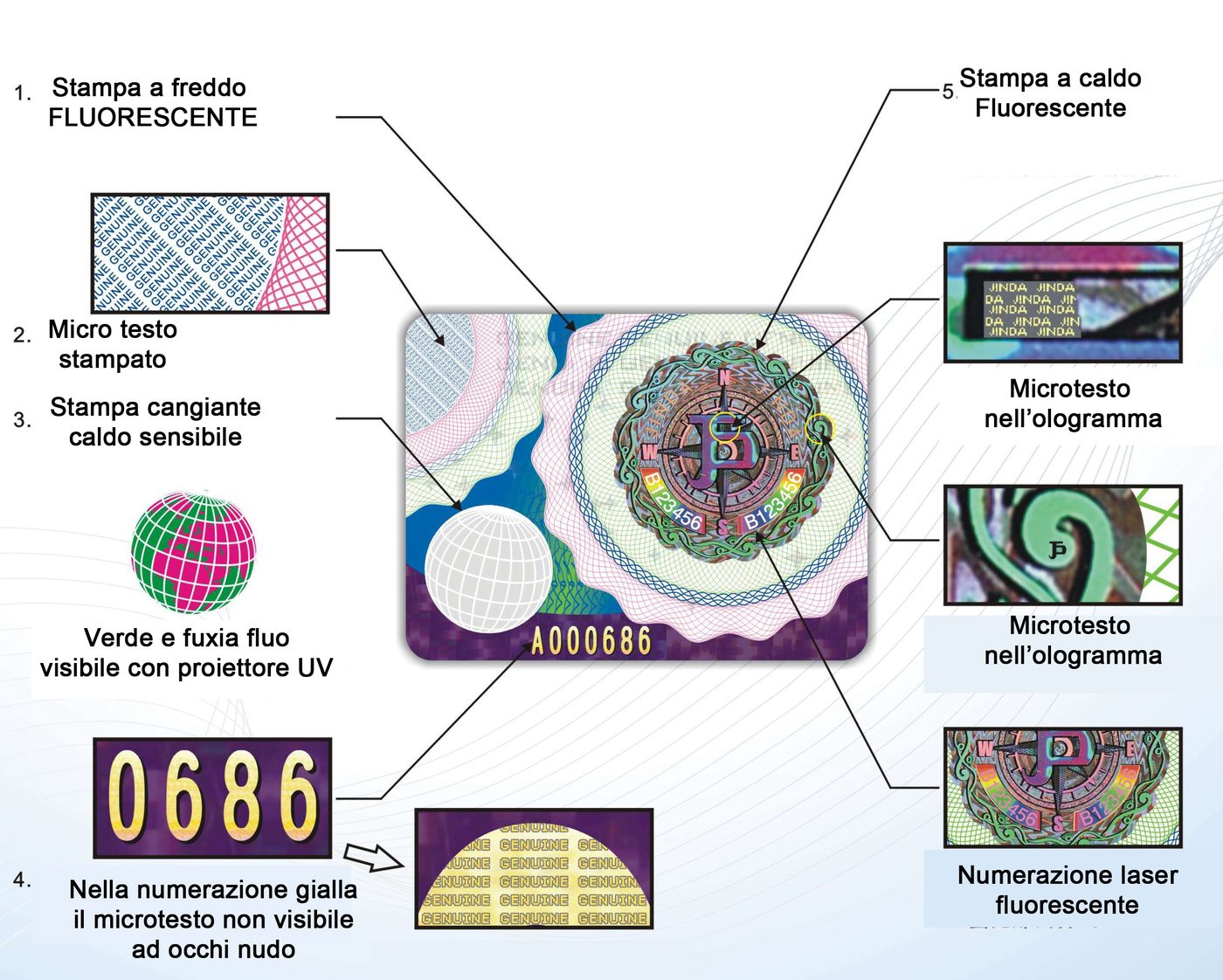
Features that can coexist in a single hologram: fluorescent print, microtext, colour-shifting print and laser numbering (labels in Italian).
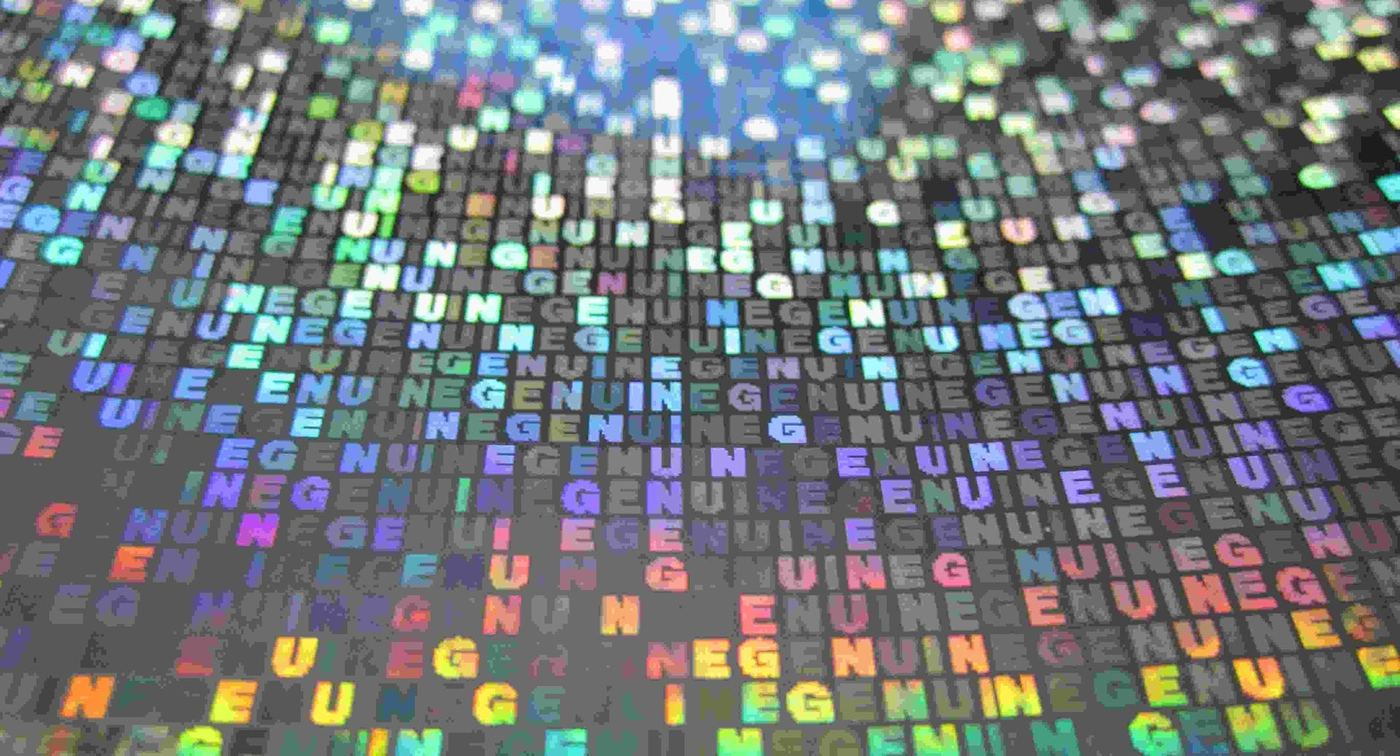
Look at the line below: it looks like a rule, but it is lettering. On holograms the microtext is smaller still and can only be read with a magnifier.
HOLO3000 GENUINE
Tamper-evident materials
The material decides what happens when someone tries to peel the label off.
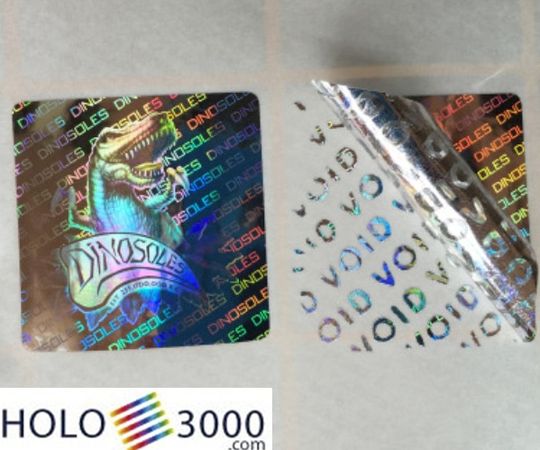
VOID: leaves the word behind
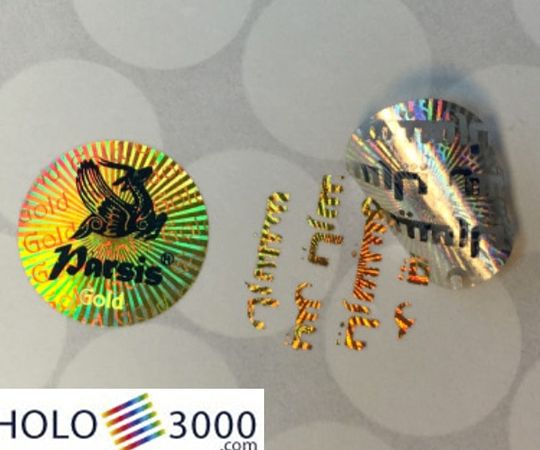
Destructible with logo
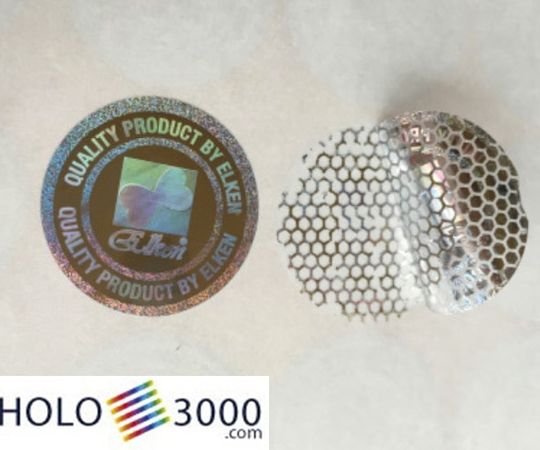
Honeycomb
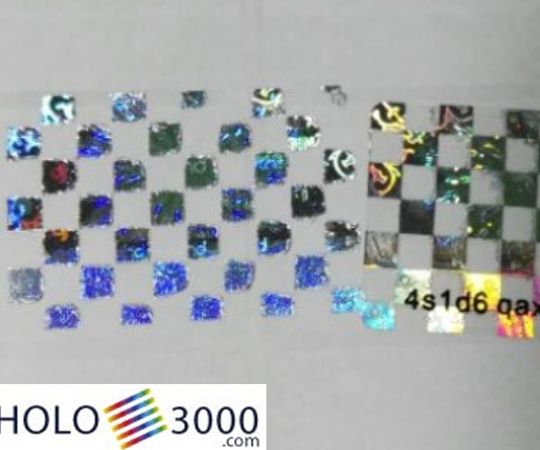
Chequered
VOID
On removal it leaves the word VOID on the surface and on the label.
Destructible
The film breaks into fragments: it cannot be peeled off whole or reapplied.
Honeycomb and chequered
On removal a pattern of cells or squares stays on the surface.
Non-destructible
Comes off whole. Suitable when only visual authentication is needed.
A short history of holography
Holography was born in the late 1940s from the work of physicist Dennis Gabor, who received the Nobel Prize in Physics for it in 1971. In 1962 Yuri Denisyuk produced in the Soviet Union the first holograms visible in white light.
Since then the hologram has become the most widespread mark of authenticity: easy for buyers to recognise, complex for counterfeiters to reproduce.
Counterfeiting: what the law says
In the European Union the matter is governed by Regulation (EU) No 608/2013, which replaced the earlier Regulation (EC) No 1383/2003.
- Counterfeit goods: products bearing without authorisation a sign identical to a registered trade mark, or one that cannot be distinguished from it in its essential aspects.
- Pirated goods: copies made without the consent of the holder of a copyright or of a design.
This information is for general guidance and does not replace legal advice.
Frequently asked questions
Can a hologram be photocopied or scanned?
No. The copy loses the holographic effect and shows up as a flat grey or coloured patch.
What is the difference between VOID and destructible?
A VOID label comes off whole but leaves the word on the surface. A destructible label breaks into fragments as it is removed.
What is the serial number for?
It makes every piece unique and lets you keep track of it in a register. See the numbered holograms available in the shop.
Can I have a hologram with my logo?
Yes. For small runs there is the custom hologram in a 980-piece batch; for larger quantities we produce holograms made to order.
How many pieces do I need to order?
In the shop, ready packs range from 60 to 980 pieces. For made-to-order productions the quantity depends on the project: request a quote.
Choose the right hologram
In-stock holograms in the shop, made-to-order productions or licensee management: write to us and we will point you to the right solution. +39 392 3326717 · info@holo3000.com